An online art exhibition showcasing young neurodivergent identities, challenging negative beliefs, and tackling stigmatising stereotypes.
About the project
This exhibition has arisen from a groundbreaking initiative, the Our Neurodivergent Experience project. The project emerged from a collaborative effort of people working in Devon, aiming to challenge negative beliefs about neurodiversity and tackle the pervasive stigma and isolation among neurodivergent young people. This unique venture not only highlights the voices of neurodivergent youth but also underscores the dire consequences of policy-makers' inaction on these critical issues.
The project, and this exhibition is the result of a University of Exeter Engaged Public Research funded collaboration between the Esteem Team, Devon Council Council’s SEND participation team, Well Image CIC and researchers at University of Exeter working together to creatively respond to concerns raised by marginalised neurodivergent young people in the South-West about lack of access to platforms to have their voices heard about topics that matter to them.
Supported by local creative arts professionals, neurodivergent young people worked with the project team to devise the prompt: “What being neurodivergent means to me” and to create an adaptable art session that enables a greater diversity of neurodivergent young people to take part, particularly those who are not in school for a variety of reasons, those who prefer not to communicate verbally and those who find it difficult to leave their homes.
The Impact
The artworks created were showcased in an exhibition illustrating young neurodivergent identities, challenging negative beliefs, and tackling stigmatising stereotypes. The exhibition was launched on June 20, 2024 at Positive Light Projects, with senior local community leaders in attendance. This event featured contributions from young participants and members of the University of Exeterʼs Student Guild and Neurodivergent and Disabled Studentsʼ Society.
This online version of the exhibition provides a lasting legacy of the artworks created by the contributing participants.
You can also see an online booklet of the exhibition here.
"Taking part in this makes me feel like I am part of a community. This feels really good as I usually feel a lot like I am on my own as a neurodivergent teenager." -
Evolution of the project
One of the young people who has been part of the project from its inception is Oakley Stratford. He tried out ideas and prompts, and worked with his mentor to put together a series of lesson plans for others to follow.
Click here to access the lesson plans
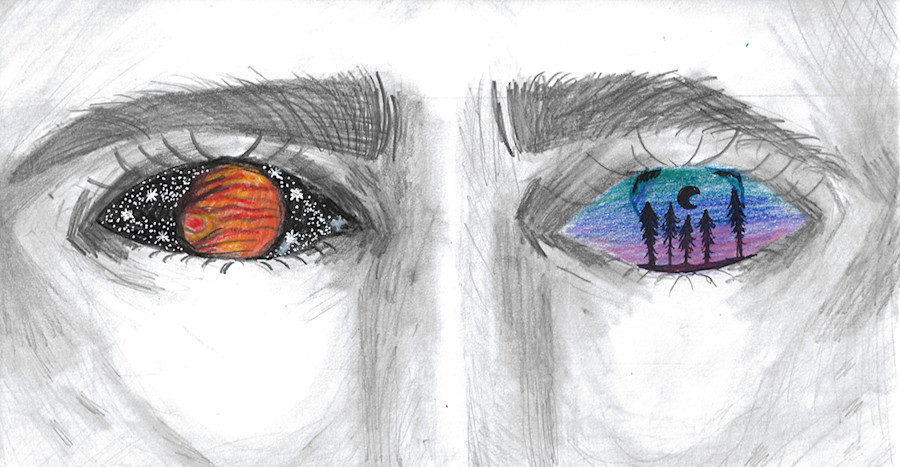
He also was keen to share his process pictures documenting the creation of his artwork that forms the main image for the exhibition, which you can see below.
Acknowledging and Valuing Different Perspectives
The project, driven by neurodivergent adults who have navigated similar challenges, emphasises the necessity for greater engagement from local leaders. Strengths-based support can significantly help neurodivergent young people break free from societal constraints and realise their full potential. The project advocates for support, awareness, and conversation about recognising and leveraging neurodivergent strengths.
The Context and Methodology
Set in a rural community, where neurodivergent young people often feel isolated, this project brought together participants aged 7-25. With diverse educational backgrounds—some in formal education, others home-educated or isolated—the project sought to capture how these young people see the world. The result is a rich tapestry of experiences and perspectives that challenge traditional notions of what it is to be neurodivergent and highlight the possibilities beyond conventional boxes.
Varied Experiences, Common Goals
Participants in the project included those comfortable talking about their neurodivergence and those discussing it for the first time. Despite their varied experiences, all participants were well-supported and showcased the potential for neurodivergent individuals to flourish in the right environment. This diverse group, with different interests and backgrounds, has brought invaluable insights to the project.
"My eye drawing reflects the focus for ND people about how others see them. This perception has negatively impacted on me in the past. I have been seen and judged by others for my neurodivergence and excluded from so much because of their views. This has affected how I see myself.
Being seen as 'weird', as different, as difficult, can be negative for neurodivergent children and teenagers. But it's not black and white. I am different, I now see that as good, it doesn't matter what others see and think. I see myself for who I am, even if others can't."
Why this matters
Urgent Need for Policy Change
Neurodivergent young people, their families, teachers, and health professionals face significant challenges due to high thresholds for support in schools and services, leaving many young people with unmet needs and poor mental health, particularly during transitions to higher education or employment. The lack of teacher training and awareness about neurodivergent needs exacerbates these issues, leading to long waits and limited resources for families seeking support.
The Office for National Statistics (ONS) reports that only 22% of autistic adults are employed. The rise in referrals for autism assessments, which have doubled since 2019, highlights the increasing demand for support. Devon County Council estimates that nearly 8,000 young people in the county aged 5-24 have neurodevelopmental conditions, including autism and learning disabilities.
The Consequences of Inaction
Neurodivergent young people and their families are severely impacted by the lack of timely support. The result is a growing number of young people moving out of school into home education or alternative provisions, record levels of poor mental health, and increased school-induced anxiety and refusal. These issues are compounded by negative cultural and historical stigma around neurodiversity.
A Call for Immediate Action
There is an urgent need for more neurodivergent-friendly social spaces, increased funding, and engagement with harder-to-reach groups. Early intervention and support can save money and resources in the long run. Investing in supportive environments where neurodivergent young people feel heard and empowered can lead to significant improvements in their mental health and educational outcomes.
The Our Neurodivergent Experience project demonstrates the profound impact of community-led research and the importance of listening to neurodivergent voices. It calls for policy-makers to recognise the value of neurodivergent minds and the urgent need for systemic change to support these individuals in reaching their full potential.
Emily Wright
A walk in my shoes
A soundscape by Mia Robillard-Day
A defining characteristic of Live Art and Spacial Practices is the body's relationship to time and space. It calls upon us to question how we exist within our surroundings. Andra McCartney writes, "Soundwalks take the everyday action of walking, and everyday sounds, and bring the audience's attention to these often ignored events, practices and processes” (McCartney 2014:212). I am curious about how this practice utilises ʻeverydayʼ actions and expands the seemly mundane to highlight a larger message. For example, in Walking Holding by Rosana Cade, the action of walking and holding hands is used to explore “the experience of queer and marginalised identities in urban environments” (Cade 2019). This has led me to deeply consider my own experience of everyday walking and sound as a disabled person.
Through my piece, I use the forms of walking and audio to explore two central questions:
- How can one use the form of an audio walk to express their unique auditory experience of space?
- How can the use of everyday actions within live art and spacial practices bridge gaps of understanding between disabled and non-disabled participants?
A Walk in my shoes aims to capture and express how a mundane act of walking down the street may be vastly more challenging and overwhelming for me as an autistic person than the average person. Sounds for me are intense, and overwhelming, and I often hear things that others do not notice. This is a common experience in the autistic community.
Throughout my process into performance I collected data from my autistic peers by asking them a set of questions:
• What sounds are most prominent to you when you walk down the street?
• What sounds cause you distress when in a public space?
• Are there any sounds that you feel you notice that others donʼt?
These answers have been collected with my own experiences, recorded, and combined to create a sensory experience which you can listen to above.
The location, Fore Street, has been specifically selected for its centrality, in hopes that most participants will have walked down it before and already have preconceived memories of how they experienced that public space, in hopes that my piece will offer an entirely different experience. It also has autobiographical significance as it is my route home every day. The motivation behind this work has become apparent to me throughout the process of the module. Interacting in drama spaces as a disabled person, it is common for me to try and mould my experience to match my neurotypical peers through sensory aids. As disabled people in society, we are taught that achieving able-bodied/neurotypical status is the ultimate goal. Robert McRuer calls this; “compulsory able-bodiedness” (McRuer 2006: 5). In almost every walk of life, we are encouraged to experience our surroundings in the most non-disabled way possible. Through my piece, I aim to turn this on its head and ask the audience to experience space from my perspective as a disabled person.
I hope through experiencing this work new understanding and discussion will be created between differently-abled individuals, and non-disabled people will take more time to consider what life is like for those who are disabled.
Bibliography
Cade, Rosana. Walking-Holding, accessed 6 2022, https://www.rosanacade.co.uk/walking-holding
McCartney, Andra. “Soundwalking: creating moving environmental sound narratives”. The Oxford Handbook of Mobile Music Studies, Volume 2. 2014. Edited by Sumanth Gopinath and Jason Stanyek. 212-237.
McRuer, Robert. "Introduction: Compulsory Able-Bodiedness and Queer/Disabled Existence." In Crip Theory: Cultural Signs of Queerness and Disability. New York and London: New York University Press, 2006. 1–32.
Our next steps
We are a group of people passionate about improving the lives of neurodivergent people across Devon. We come to this from professional experience working across a diverse range of organisations, and also as individuals with lived experience of neurodivergence. We would love for you to join us. Please sign up to hear more about our plans and to help shape what we do in the future: https://forms.office.com/e/4vW6aK6eSG
Key Policy Points/actions
-
Collaborate with researchers to use up to date research
-
Develop neurodivergent policies and strategies with neurodivergent staff/academics or consultants to inform from a neurodivergent and neurodiversity-affirming perspective
-
Liaise with community/family support groups
-
Letʼs start a county wide conference about what does it mean to be educated and what it means to belong in education
The Team
Project Partners
University of Exeter
Room 153, Queen's Building
The Queen's Drive
Exeter EX4 4QH