A spotlight on one of the 12 artists/art collectives showing work as part of the Environment and Sustainability Institute (ESI) Creative Exchange exhibition 'Catalyst'. In this blog discover more about Cornwall based photographer Josie Purcell.
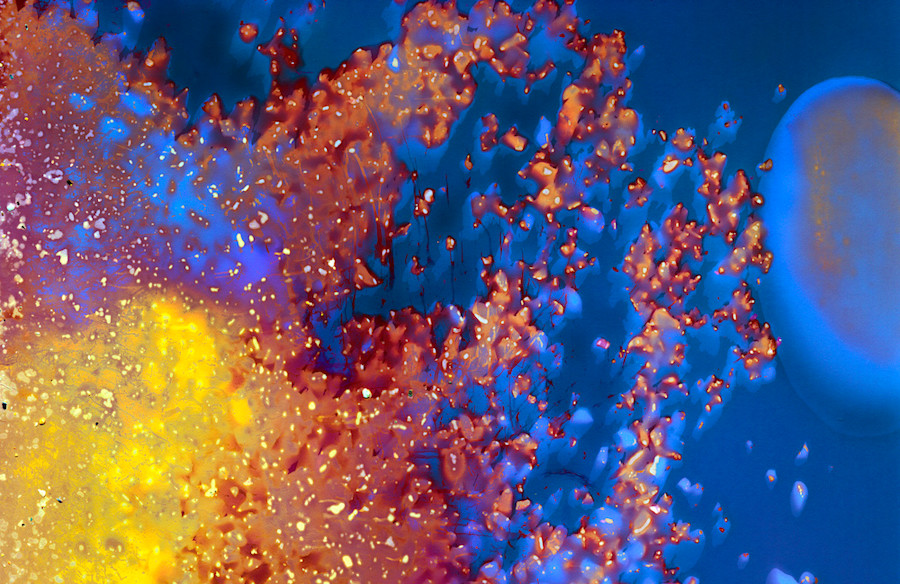
Josie Purcell is a photographer who uses alternative photographic processes to create curiosity and spark conversation about diverse environments and the human impact on them.
Her creativity is driven by our place within the natural world and our connections to natural resources such as water, soil, and sand. She is intrigued by the vastness of space and our relationship with our sun, moon and stars, the potency of science, and the mystery of fables and folklore. Her work is often rooted in abstract forms and she is fascinated by the psychology of aesthetics, with a particular interest in how non-documentary images provoke a response in the viewer.
Her coastal and rural surroundings are her artist’s palette. She can often be found making work in-situ near the ocean or by the rivers, fields and woodlands where she lives. Predominantly using alternative photographic processes, Josie looks to create curiosity and spark conversation about diverse environments and the human impact on them. She has been devising and implementing sustainable photographic techniques for some time to reduce the environmental impact of her photographic practice.
Josie created Cornwall’s first/only alternative photography mobile darkroom, ShutterPod, in 2014. She continues to teach and hold workshops in techniques such as anthotype, cyanotype, and chemical-free lumen printing.
In September 2018, Josie gained a distinction in her MA in Photography via Falmouth University.
As humans, we have the ability to create marvels but also the ability to be destructive. I hope people can see wonder through my images but remember the reasons why they exist and be inspired to do more for the world we rely on.
In 2017 she collaborated with Dr. Grace Twiston-Davies from the ESI on the'6000 Flowers: Farms for AONBees Pollinators’ project. Together they explored the importance of bees to human existence and the need for agriculture to support them via informed land management practices in Cornwall. Since her collaboration with the ESI Josie predominantly works on environmental issues and has created the Photopocene podcast to share the imagery of other eco-conscious photo artists in an audio way.
Working with the researcher at the ESI has been a catalyst for so much of my work. Being able to mix science with art has been a huge bonus to my practice and ideas for ongoing projects.
Almost all of Josie's new work since '6000 Flowers' has related to environmental issues including the three pieces she is exhibiting as part of 'Catalyst'.
Two of the works are from her 'Harena Now' series which considers the global sand crisis, a still lesser known environmental issue that has huge consequences, not only for the environment but human life too. Sand mafias actually exist and people have been murdered due to sand.
The remaining piece is taking from her most recent project 'Part of the Patchwork' (POTP) which contends with the idea of land ownership, access to land, self-sufficiency, impacts on biodiversity, climate and water resource, and social and cultural histories through the prism of life on a north Cornish coast allotment site.
You can view all three pieces by visting the virtual ESI gallery, just click on the image below.
About 'Catalyst'
Showcasing nearly a decade of arts/science collaborations at the the University of Exeter's Environment and Sustainability Institute, Penryn, Catalyst features new work by twelve artists, all of whome have previously worked with researchers as part of the ESI Creative Exchange.
University of Exeter
Room 153, Queen's Building
The Queen's Drive
Exeter EX4 4QH