Hannah Mumby is an artist and creative facilitator based just outside Exeter. She is actively interested in working with academics to help bring research to life, and using creativity to share ideas with wider communities beyond academia.
In this blog she shares with us more about creating the Co-Production Oracle as part of a Creative Residency at the University of Exeter's Global System's Institute (GSI).
Introduction
In April 2022, I was invited to pursue a Creative Residency at the Global Systems Institute (GSI) at the University of Exeter. The GSI was looking for an illustrator or graphic artist to investigate the ways in which members of the GSI use co-production, which is one of the core values of the GSI. Over a period of four months I developed an understanding of co-production as a complex process that researchers at the University negotiate in their research and relationships, and I was able to use my creative practice to open up this issue and give the community the tools to have a deeper level of engagement that hopefully will stretch into its future. I am pleased to be able to share the insights I gained throughout my creative investigation. Headings in this blog are phrases lifted from interview transcripts from the residency.
"A Two Way Flow"
The brief suggested that my creative residency should begin with conversations with members of the GSI about co-production, with the aim of mutually-beneficial exchange, where both the community and myself as a practitioner would gain new insights. There was a specific output expected from the residency: a toolkit that would enable the GSI to better understand co-production and embed it more within collaborative practice. Apart from this, at this stage, the content of the residency was open to interpretation.
I was encouraged to be a trouble-maker, and to be curious about the mess and contradictions that might emerge from my investigations.
In April 2022, on my first day out of my flat since recovering from Covid-19, I ventured to Byrne House, on the University of Exeter’s Streatham Campus, to meet with Dr Ernesto Schwartz-Marin, who was to frame the residency and help me put my investigation into some kind of context. Our conversations on this day and others which followed, set the tone for my residency: I was encouraged to be a trouble-maker, and to be curious about the mess and contradictions that might emerge from my investigations. This resonated with me as a practitioner who is suspicious of straightforward narratives, and I felt inspired to begin a process that could seek to undo any pre-conceptions about straightforward approaches to co-production.
Climbing up the steep stairs to the Tower Room, I hoped to take my interviewees on an adventure into a different dimension.
I began the residency by arranging conversations with members of the GSI. I sent out an open call to invite as many community members as possible up to the Tower Room at Byrne House to have a recorded conversation about co-production. I chose this location - up in the roof in a hidden enclave that was unknown to many people - because it felt appropriate as a space away from people’s natural habitat, or well-trodden paths on campus. Climbing up the steep stairs to the Tower Room, I hoped to take my interviewees on an adventure into a different dimension - a private space with a view of the beautiful gardens on campus, where they could reflect and doodle on a big pad of paper, and be in the company of someone who was there to listen closely and open up a reflective space.
I arranged 19 conversations with members of the GSI community, from diverse but mostly science-based disciplines: geographers, astrophysicists, mathematicians, engineers and systems thinkers, amongst others. The conversations were directed by the prompt, 'what does co-production mean to you?' and participants were encouraged to respond in any way that felt relevant to them, using the coloured markers and paper to visually elaborate on concepts and metaphors, as they explained them to me. I audio-recorded the conversations, and with the help of Otter.ai (a transcription app) was able to create accurate transcriptions of participants’ speech.
What soon became apparent was that each participant had curious, idiosyncratic turns of phrase that added another level to the narratives that were being communicated. Participants would use metaphors that often drew on symbolism from their own field of research, and would find analogies to describe power dynamics and relationships that I had never come across before.
"It’s messy, I don’t think it’s a neatly packaged thing"
Through these conversations I was able to understand some of the difficult territory of co-production and identify some interesting recurring themes, including the following:
- Hierarchy within research teams can dictate the direction of research
- In any community or collaboration, some approaches / disciplines might be valued more than others
- Some can experience feeling left out or on the periphery of a group - some voices are louder than others
- Distribution of money can create tension around capacity to contribute to a shared piece of work
- Different cultural traditions can create a clash in ways of working or communicating
- Researchers may already have an agenda for working with a community (and may have a 'solution' in mind) before even consulting that community
- There was an attitude I encountered a few times of "If only the public would understand the research, then everyone would change their behaviour for the better"
- I also kept hearing versions of the notion, "I have the best and most important solution to the problem, we should focus all our energy on this"
I wanted to create a tool that could actually invite people to be more curious about this complexity, that could open up difficult questions and create opportunities for people to be challenged by new points of view.
I was bearing in mind that the brief for my residency had explicitly mentioned a 'toolkit' as an output - something that could help the GSI community better understand how to 'do' co-production. However, as the conversations unfurled, the landscape of co-production was revealing itself to be something fraught with difficulty around power, relationships, navigating tensions and difference, and tolerance of the messiness of the process and the potential for failure. I wanted to create a tool that could actually invite people to be more curious about this complexity, that could open up difficult questions and create opportunities for people to be challenged by new points of view. It felt important to conceive of a tool that could actually resist the impulse to find neat solutions to problems, and instead help people open up more to a sense of not knowing the answer, and help them practice becoming more tolerant of messiness.
I had, in the back of my mind, been thinking about Brian Eno’s Oblique Strategies - a deck of cards with provocative, strange prompts on them, which Eno describes as 'a device for breaking mental habits'. In an interview about his card deck, he says:
[Creating the Oblique Strategies deck] came about because I noticed that in pressure situations … you tend to fall back on the old solutions, because you don’t want to take the risk of going down a road that doesn’t pay off at all. And then you get stuck.
[As artists] we practice imagining, we practice thinking about how other worlds could be, how other minds could be, how other people could be, how other lands could be … it’s one of the primary ways we understand the world.
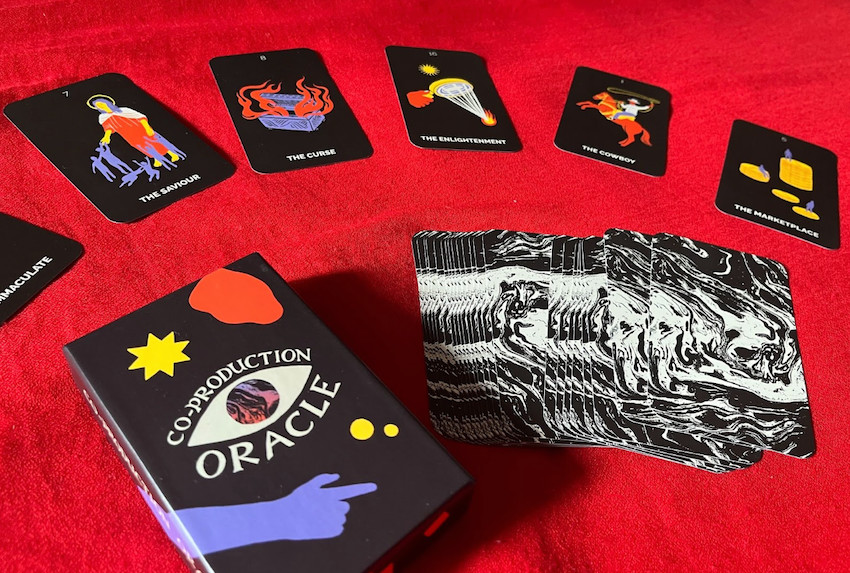
I had also been interested previously in Tarot and Oracle Card decks as tools which provided randomly-drawn prompts that could help the reader to see their life, or a particular situation, from a new point of view. I spoke to Ernesto at one of our many meetings about the idea of making a card deck that could somehow function in this way, but with a focus on co-production. Immediately, this idea seemed lively and generative: Ernesto was familiar with the Tarot already, and we discussed what a deck of cards about co-production might look like. Over the subsequent months we worked together to identify some of the important facets of co-production that should be featured in the deck. We discussed the themes and metaphors that had emerged from the conversations, and consulted with Professor Sarah Hartley - who has published research on co-producing knowledge across disciplines and borders, and transformation and slippage in co-production - to refine the terrain we were covering and make sure we hadn’t missed anything that felt important to represent.
What came next was to refine the themes into 30 short prompts and assign these a title that would somehow sum up each issue by turning it into an archetype.
“What are we allowed to say? / What this really means”
One condition of my residency was to present a ‘work in progress’ at the GSI summer retreat in North Devon. I wanted to use this gathering as an opportunity to test whether the emerging card deck would function as intended, and so I made a prototype version using flash-cards onto which I simply wrote the title of each archetype, and then rounded the corners with a corner-cutter, to make them look like oracle cards.
... there are endless possibilities hidden in objects that you can repurpose from unsuspecting corners of your home.
In my history as a creative practitioner there is a chapter of a few years where my partner and I ran an interactive, immersive pop-up cinema called Butterscotch Sunday. Together we crafted one-off events where we would create by hand props, food, costumes and settings to conjure up magical, theatrical experiences that would wrap around the screening of a film in order to take the audience on an immersive and memorable journey and bring the film to life (think of a home-grown version of Secret Cinema). We created, for instance: an edible screening of Amelie; a ghost-train inspired by Mulholland Drive, and even an unsettling screening of Antichrist in a hut, with a candle-lit journey into the surrounding woodland to hear live performances of folk songs about witches. The reason I’m explaining this, is to give some context that I have a history of constructing rather elaborate, hand-made interactive sets and experiences, because I love to create memorable encounters that are saturated with drama and intrigue, and can help people playfully engage with a subject.
One participant who had received a card reading sent some feedback after the end of the retreat:
It was such a mind-opening experience. It made me realise that sometimes my mental models limit my perspective on how I see the world, and having such a chat allowed me to see from a different perspective and through the experience of others. It even felt relieving and medicinal! And made me realise the importance of a community - to be happy so I could be of help to others, through my work, my company and even as I person. I just loved it!
People also reported to me during the event that coming to speak with the ‘Oracle’ offered them a space away from the schedule where they could reflect and talk about how they felt about their work, and that this was quite unusual and much-needed. I was beginning to get a sense that this sort of intervention could be quite powerful in creating space for researchers to explore their practice in a way that was open-ended and not focused on finding immediate solutions.
"If somebody says something, then you’ll dig into it / You build up a sort of a picture"
After returning from the retreat, I had one month remaining to design and produce the card deck, so I had to get to work quickly creating illustrations for the faces of the cards, based on the 30 archetypes. Simultaneously, I was working with Ernesto to refine the text of the prompts, and write an instruction booklet that would guide people through the process of using the deck of cards and provide some contextual information.
Having to work so quickly (sometimes finishing the designs for up to 3 cards, from scratch, in a day) meant I had to employ an illustration style that was bold and simple. Here are some examples of the finished cards, with their prompts:
The next task was to design the box for the cards, and a booklet that could be folded up and put inside:
These were all sent off to be printed by a custom card deck manufacturer in the north of England, and I breathed a sigh of relief, looking forward to holding them in my hands.
The results were beautiful, and just what I had hoped for!
It was a lovely moment seeing Ernesto interact with the cards for the first time, celebrating what we had created together.
In November 2022 I hosted a launch event where members of the GSI (and beyond) were invited to hear about the creation of the deck, take part in some interactive activities to learn how to use the cards, and take decks away with them to give them a life in the outside world.
I was delighted that Professor Tim Lenton took five decks away with him at the end of the launch, to distribute and use in his meetings.
Since the launch, I have been running workshops using the card deck within the University of Exeter, and beyond (for community-focused projects at the University of Plymouth, and with multi-partner Arts Council funded projects for instance).
Most recently, I facilitated a set of workshops with members of the Arts and Culture, University of Exeter Critical Friends Network at both the Penryn and Streatham campuses. The purpose of these workshops was to get people involved with using the card deck through a sequence of interactive group activities that firstly looked at a generic question, and then moved into more intimate clusters where attendees could bring their own questions relating to areas of stuck-ness of complexity in their work, research or other areas of professional practice, with a focus on co-production, collaboration or projects where they were working with others.
These have been lively, engaging sessions where I have guided participants to learn and practice reflective listening in order to help each other open up and explore important questions and challenges, getting into the nitty gritty of their relationship to the issues they are working with.
It has been clear from people’s feedback to these workshops that the cards are “powerful”, that they work as a tool to get deeper into issues together, and that the process of using them, even with a stranger, can help build relationships and foster solidarity. Working in small groups has proven a particularly powerful format. In this situation where each individual is given an opportunity to bring an issue they need a new perspective on, having cards and prompts to refer to somehow takes the pressure off that person to come up with fully-formed statements about the challenges they face, and instead invites them to respond to questions, and unravel layers of associations in the presence of others who are there to witness and support their exploration.
Interested in using the Co-Production Oracle?
If you're interested in the possibility of using the Co-Production Oracle with your team, department, network or organisation, Hannah is available to facilitate workshops. You can contact her directly on hello@hannahmumby.co.uk
University of Exeter
Room 153, Queen's Building
The Queen's Drive
Exeter EX4 4QH