University of Exeter PhD student Giulia Nicolini, shares with us more about collaborating with Kerry Holbrook and Ruth Klückers from The Seaweed Institute to document seaweed’s uses as a food in Cornwall.
‘Seaweed Eating Archive’ aims to document the different ways in which people relate to seaweeds as food in Cornwall, by crowd-sourcing stories, recipes, memories and other accounts of everyday seaweed consumption. The project is a collaboration with Kerry Holbrook and Ruth Klückers, co-founders of The Seaweed Institute, and is part of my PhD research on seaweed as a food in the UK and the southwest.
The collaboration stemmed from a shared interest in understanding how people in Cornwall may have eaten seaweed in the past, how it is eaten today, and how this might be changing.
In recent years, seaweed has experienced something of a culinary revival in the UK. While it is increasingly framed as a ‘future food’, we know that people have eaten seaweed around the UK for thousands of years. And yet, seaweed’s historical use as a food seems to be less well remembered in Cornwall compared to Scotland, Wales and Ireland – or even north Devon – where there are still living memories of foraging for and cooking with laver, dulse and carrageen.
The idea of creating an archive is a playful response to the apparent absence of seaweed from Cornish historical records – or at least references to its culinary uses.
If you go looking for seaweed in the Cornish archives, you’re more likely to find it in the works of 17th and 18th century botanists and phycologists, like Cornishman John Stackhouse’s Nereis Britannica, an illustrated compendium of seaweeds. Or in black and white photos of farmers collecting washed up seaweed, to spread on their fields as fertilizer.
To help fill this gap, we plan to deposit the entries as a collection at Kresen Kernow at the end of the project. We will collect submissions on postcards at a pop-up stall at events around Cornwall, and via an online submission form, until 31 December 2025. The custom-made postcards incorporate archival images from Penlee House and Kew Gardens – again linking to seaweed’s historical representations – as well as contemporary photographs and seaweed pressings by Ruth and Kerry.
Initially, we envisaged creating a kind of public ‘living archive’ – an online repository that could be viewed by anyone for the duration of the project. It would play a double function: documenting how people eat seaweed, but also feeding people who don’t with ideas and inspiration. We quickly came up against some practical challenges, however, and with only a small budget to work with, we decided to focus on gathering the material for the archive, and ensuring it would be accessible to anyone in perpetuity.
We always envisaged the process of creating the archive as an opportunity to have conversations about seaweed, and for people to learn about and explore seaweeds in creative and multi-sensorial ways.
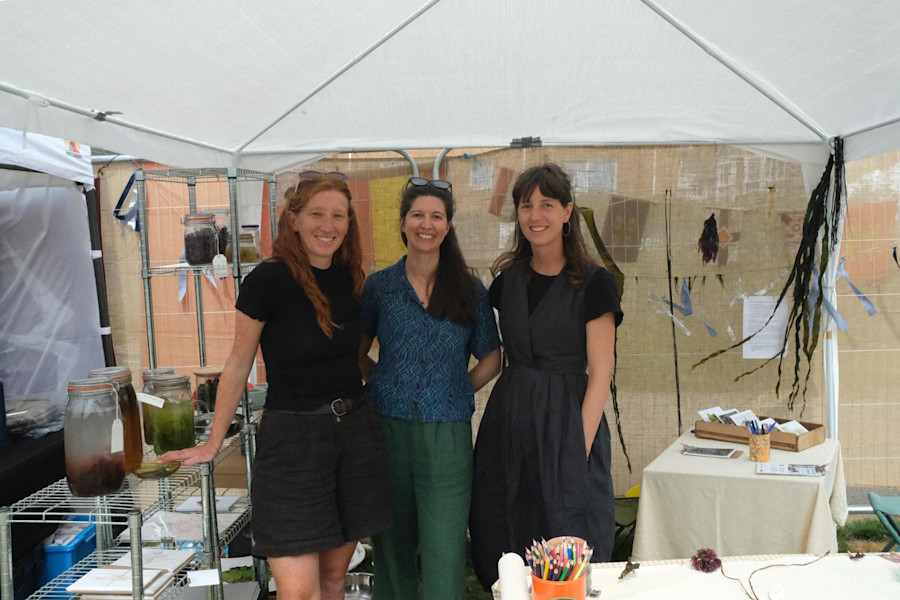
Our pop-up stall has therefore been designed as a space where people can look at, touch, smell, taste, and draw different species of seaweed. At the heart of the stall is a set of modular shelves filled with jars of fresh and dried seaweeds, that we use as prompts to talk about different species, their properties and uses. The shelves are also central to the project’s visual identity. They are a nod to both the kitchen pantry, but also apothecaries of old, with their labelled jars of curiosities – which seems fitting in light of seaweed’s historical and contemporary uses as both food and medicine.
Through the process of creating the archive, we hope to make visible Cornwall’s hidden seaweed histories. But the project is as much about enquiring into the future as it is about documenting the past. I am interested in critical approaches to the archive, and drew inspiration from Nora Almeida and Jen Hoyer’s idea that the archive could be a ‘site where new imaginative possibilities emerge’, and that can ‘produce socio-political and ecological change’ in the Anthropocene.
By mapping seaweed eating practices in Cornwall, we aim to provide nuanced, place-based insights into who is eating seaweed, how and why.
These could be a valuable counterpoint to some of the ideas that tend to dominate within the media and the UK’s emerging seaweed industry – for example, of seaweed as an ‘alternative protein.’ Ultimately, we hope that Seaweed Eating Archive will promote creative engagement with seaweed, and inform conversations not only about the future of seaweed, but also the future of food, in Cornwall and beyond.
The Seaweed Eating Archive project is funded thanks to a Dissertation Fieldwork Grant from the Wenner-Gren Foundation. The project runs until 31 December 2025. We will be hosting a pop-up stall at Coverack Lifeboat Day on 9th August. We will also be at Kresen Kernow in September and October. Please follow The Seaweed Institute on Instagram for further updates.
You can contribute to the Seaweed Eating Archive online here.
About Giulia Nicolini
Giulia is a PhD student in Anthropology based at the Centre for Rural Policy Research, University of Exeter. Her research interests sit at the intersection of food, culture, society and environment. Her doctoral research looks at how taste and demand for seaweed are changing in the UK, with a focus on the southwest. She also works at the International Institute for Environment and Development. Giulia holds an MA in Anthropology of Food from SOAS.
About The Seaweed Institute
The Seaweed Institute is a social enterprise with the aim of promoting sustainable and joyful engagement with seaweed. We seek to learn and share knowledge about seaweed, its ecology and cultural history, whilst advocating against overexploitation. We run workshops and design activities to share knowledge on seaweed’s ecological significance, cultural heritage and varied uses.
University of Exeter
Room 153, Queen's Building
The Queen's Drive
Exeter EX4 4QH