This online exhibition developed by Dr Tim Cockerill and Dr Elze Hesse showcases a stunning series of large-scale macro photographic images which visualise how social and environmental cues can affect how bacteria swarm collaboratively.
Part of 'Underworlds', an extended programme of art-science collaborations hosted by the Environment and Sustainability Institute Creative Exchange.
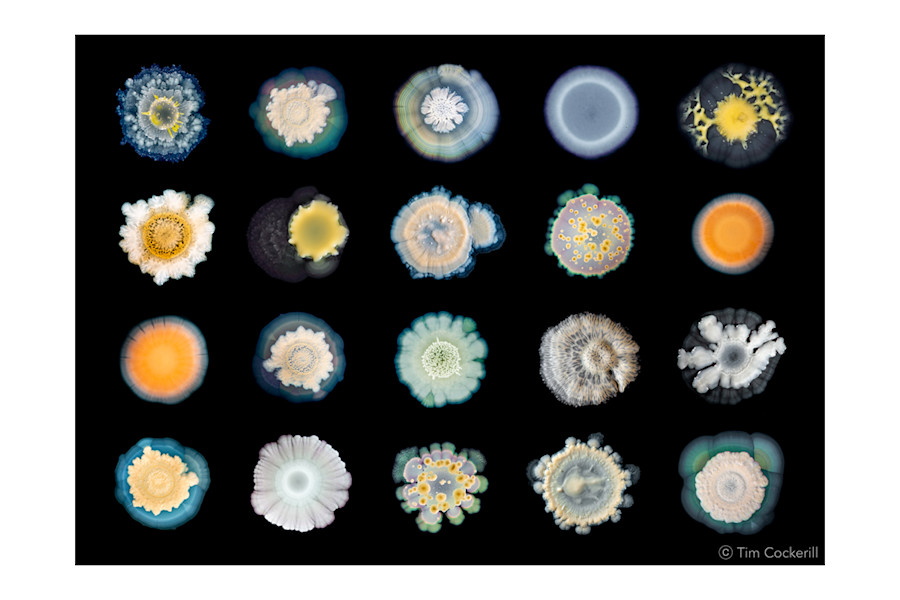
Bacteria are everywhere. They can be found in astonishing diversity and abundance throughout most of our planet, their total mass on earth outweighing all animals and plants combined. Some bacteria can cause disease, illness, and infection; others exist in an intimate symbiosis with their hosts, without which it is unlikely either could survive. They give us botulism, syphilis and bubonic plague, but also yogurt, salami, and sourdough bread.
Bacteria do not grow alone, but live in dense groups where they interact with many others. This exhibition shows the diversity of forms that emerge when bacteria grow, with most of the colonies consisting of two strains of bacteria growing together. The bacterial species were isolated from metal-contaminated soils in Cornwall and from ordinary potting compost.
Understanding why species help each other may allow us to predict how bacteria explore their environment and decide whether to stay or go. Importantly, we can manipulate these interactions to our own benefit – they could help us reduce virulence and antibiotic resistance in harmful bacteria, but also harness the powers of beneficial species to remove toxins from polluted areas.
Bacterial species were isolated by taking soil samples, diluting these in sterile water and transferring the resultant soil washes to nutrient agar, a medium for growing bacteria. Individual varieties were picked and their identity confirmed using Sanger sequencing, a method of decoding DNA.
Variovorax
The three images below show how a single species of bacterium can take a multitude of forms when grown alone or together with other species. Each depicts the common soil bacterium Variovorax, which was isolated from potting compost.
Dr Tim Cockerill is a photographer and science communicator from the Institute of Photography at Falmouth University. Specialising in macro photography, he champions organisms that are often overlooked because of their size. Dr Elze Hesse is a Research Fellow working in the Environment and Sustainability Institute. Using a wide range of model organisms (plants, bacteria and phages), her current research examines how microbial behaviour is affected by environmental challenges, including those arising from human activities.
In collaboration they have been conducting experiments using Paenibacillus, a bacterium often found in soil. Their work explores the swarming behaviour of Paenibacillus and how it is affected by the presence of other bacterial species and by stress from toxic heavy metals. Several of these bacterial species have been isolated from Cornish soils contaminated with a wide range of toxic heavy metals through mining, and others have been collected from ordinary garden compost.
This exhibition is one in a series of exhibitions supported by the University of Exeter's ESI Creative Exchange.
Scroll down to view the large-scale macro photographic images of bacteria taken by Tim Cockerill.
Please note that the images in this online exhibition must not be reproduced without the copyright holder's permission.
University of Exeter
Room 153, Queen's Building
The Queen's Drive
Exeter EX4 4QH